
The Fourth Plinth’s newest artwork stands as monument for trans communities

The newest sculpture to take over Trafalgar Square’s Fourth Plinth has been unveiled and pays tribute to the trans community.
The work, ‘Mil Veces un Instante (A Thousand Times in an Instant)’ by Mexican artist Teresa Margolles is made up of plaster casts of the faces of 726 trans, non-binary, and gender non-conforming people.
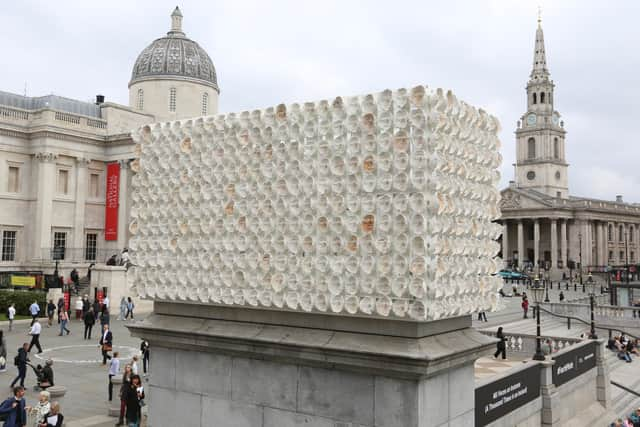

It is the 15th work to be installed on the Fourth Plinth and stands for the rights of trans communities worldwide.
It also pays tribute to one of the artist’s friends, a transgender woman named Karla, who was murdered in Juárez, Mexico in December 2015.
The casts, which were made in Mexico and London, are arranged around the plinth in the form of a tzompantli, a skull rack that featured in Mesoamerican civilisations, used to display the remains of war captives or sacrificial victims.

The work will begin to naturally age whilst on the Fourth Plinth, with the detail of the faces slowly fading as the plaster is exposed to London’s weather.
Margolles said: “This collective sculpture, which brings together the faces of 726 people living in the United Kingdom and Mexico, stands not only as a display of resilience and humanity from the trans plus/non-binary community but also as a reminder of the murders and disappearances that still occur, especially in Latin America.
“Through this structure, Mil Veces un Instante (A Thousand Times in an Instant), there is a return to the human, the primal, the sacred.”
Margolles trained as a forensic pathologist and worked as a mortician in Mexico City.
Her previous artwork was influenced by the nameless victims of drug-trafficking violence, whose unidentifiable bodies passed through the morgue.
Margolles’s work will be in place for two years before being replaced by a work by American artist Tschabalala Self, with Romanian sculptor Andra Ursuta taking over in 2028.