
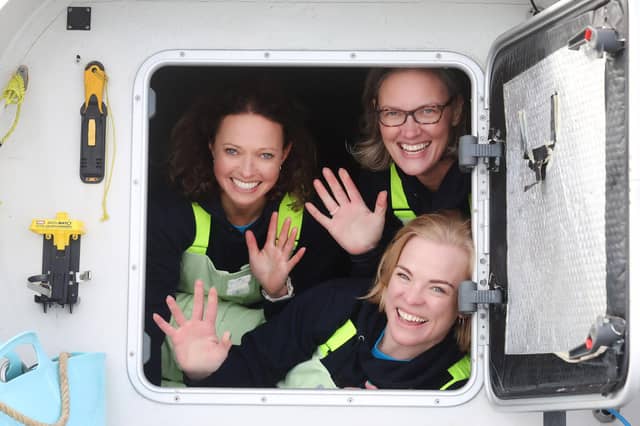

Double cancer survivor, Janette Potgieter - known as JP - from Surbiton, south west London, is one of the Row for Life team who say they refuse to be defined by life's storms and are taking on the challenge, not despite their struggles, but because of them.
The row is the women's that midlife women are just getting started – that mothers don’t lose their edge and that cancer survivors can still chase horizons.
Their epic journey will raise money for Cancer Research UK.
- The Row for Life crew is:
- JP, 43, a forensic corporate investigator. JP is also the Skipper. She rowed the Atlantic Ocean in 2021, with One Ocean Crew.
- Felicity Ashley, 49, a best-selling author, keynote speaker and mother of three from Oxfordshire. She rowed the Atlantic Ocean in 2021, with The Mothership.
- Victoria Peddie Bell, 50, a mother of two from Glasgow, now living in Geneva. She works in finance and had never been in a rowing boat until earlier this month (Jan 2026).
Felicity has had bowel cancer, JP has twice had melanoma skin cancer, and Victoria lost her father to neuro endocrine cancer. Felicity also Lost her father to renal cancer.
The crew will set off in June 2026, rowing from Monterey, California to Kaua’i, Hawaii. They will be in an open, unsupported ocean rowing boat, the length of two small cars, and without any creature comforts – their toilet is a bucket.
As well as the unpredictable and powerful forces of Mother Nature, they will also need resilience to deal with sleep deprivation, chafing skin, sea sickness and the relentless strain on the body and mind, of rowing two hours on and two hours off, 24 hours a day.
They hope to make it to Hawaii in less than 40 days.
“We’re rowing for every woman who’s been told she’s not strong enough or should play it safe. And we’ll be carrying with us everyone fighting their own battles,” said Felicity.
“Every stroke will honour the strength we’ve discovered through adversity – the grit that carried us through chemotherapy, the resilience that turns self-doubt into determination and the power that emerges when women support each other.
“And we row in partnership with Cancer Research UK, whose vital work gives hope to millions facing the fight of their lives.”
JP grew up in sunny South Africa and admits she did not always follow sound advice from her parents to look after her skin.
“Despite my parents’ best efforts to protect me from the sun, I grew up pushing boundaries and underestimating the long-term impact of sun exposure – something many young people do before experience catches up with them.
“I’m fair-skinned, blond, and blue-eyed, and like so many people growing up in a sun-soaked country, I chased a tan without fully understanding the risks.
“I now know how to take on mountains and oceans responsibly – protecting my skin, respecting my limits and making smart choices that allow me to keep pushing myself without ignoring the lessons my body has taught me.”
Her first melanoma was found when she was 23. She went to the doctor, had a biopsy the following day and surgery just a couple of days later.
Then, nearly ten years later, after moving to the UK, she had a second melanoma diagnosis.
“Fortunately, being vigilant about my skin paid off, and surgery alone was enough to remove all traces of cancer both times.
“These days, I keep a close eye on my skin and have had several biopsies, which thankfully turned out to be either benign or basal cell carcinoma (BCC).
“I know much of the sun damage was done years ago, which means I’ll always need to stay attentive to my skin and any changes.
“Regular check-ups with my dermatologist are simply part of life now – and I’m grateful to be healthy, informed and able to keep doing the things I love”.
Felicity has had bowel cancer, JP has twice had melanoma skin cancer, and Victoria lost her father to neuro endocrine cancer. Felicity also Lost her father to renal cancer.
The crew will set off in June 2026, rowing from Monterey, California to Kaua’i, Hawaii. They will be in an open, unsupported ocean rowing boat, the length of two small cars, and without any creature comforts – their toilet is a bucket.
As well as the unpredictable and powerful forces of Mother Nature, they will also need resilience to deal with sleep deprivation, chafing skin, sea sickness and the relentless strain on the body and mind, of rowing two hours on and two hours off, 24 hours a day. They hope to make it to Hawaii in less than 40 days.
“We’re rowing for every woman who’s been told she’s not strong enough or should play it safe. And we’ll be carrying with us everyone fighting their own battles,” said Felicity.
“Every stroke will honour the strength we’ve discovered through adversity – the grit that carried us through chemotherapy, the resilience that turns self-doubt into determination and the power that emerges when women support each other. And we row in partnership with Cancer Research UK, whose vital work gives hope to millions facing the fight of their lives.”
Felicity is married to Paul and mother to three children, Sam, 13, Ben, 10, and Grace, eight.
In 2021, she rowed the Atlantic Ocean with three other women in a team called The Mothership, unaware that she had bowel cancer.
On her return, she underwent surgery and then four months of chemotherapy. She took the advice of a consultant to ‘tackle cancer like you tackled the Atlantic’.
While navigating her own cancer treatment, Felicity lost her father, Bob, to renal cancer. Bob had been diagnosed with stage four renal cancer four years previously, but was well enough to travel to the start and finish of the Atlantic race to support Felicity, alongside younger sister, Pip.
“It was devastating to lose Dad, who died the day after I started chemo. I know how proud he was of Pip and me, and how much he treasured coming out to Antigua to see us finish the race.
“I’ve always wanted to do another ocean row. Last year I did the Tenzing Hillary Everest Marathon, which involves a 10-day trek to base camp, followed by a marathon.
“This year is my fourth anniversary of being diagnosed with cancer, so it feels like the perfect time to return to my ocean-rowing roots. It feels like I’m proving that I’m not just better, I’m stronger,” she said.
Victoria, mother to teenagers Charlotte, 16, and Cameron, 14, helped nurse her father Donald in his final days after he was diagnosed with neuro-endocrine cancer.
“A tumour was found on my father’s pancreas in August 2019. You fear the worst with the pancreas, so being told he had neuro-endocrine cancer was almost a relief. He had just over two great years with only a few bumps along the way. But in January 2022, he was told there was nothing else that could be done.
“Myself, my mum and my two sisters cared for him at home, for three weeks until he passed away. It was devastating, but also a huge privilege to help him in his final days. People working in palliative care are angels.
“This row represents several things for me. It’s deeply personal. I’ve taken on demanding roles and big responsibilities throughout my career, but having turned 50 a month ago, this felt like the right moment to do something for myself — something entirely new. I had never been in a rowing boat until earlier this month, so there was a definite sense of ‘in for a penny, in for a pound,’ as my father would have said.
“It will also be a time for reflection and remembrance — a chance to honour what has shaped me and why this cause matters so much.
“And above all, I hope it encourages my children, and others watching, to think differently about what’s possible. Especially for midlife women, this is a reminder that our horizons don’t shrink with age — they expand. The best is still ahead.”
For Felicity, leaving her children behind this time, will be harder than during her Atlantic row in 2021.
“In some ways it’s harder because the children are older, more aware of what I’m doing and what two months away means.
“So, it will be emotionally tougher for them and me to be away from them. And I couldn’t do this without the full support of my husband and the support of the crew around me.”
The women say this challenge will be shorter but tougher than an Atlantic crossing.
“This challenge is going to be darker, wetter, colder, certainly at the start, whereas the Atlantic was pretty sunny all the way through, so we need to mentally adjust to the differences,” said Felicity.
“You don’t know how long it’s going to be from push off at the start line, when you lose sight of land, and whether it will be five, six or seven weeks before you see land again and the people waiting for you.
“It’s about keeping mentally strong over such a long period of time, when things start falling apart, and things start hurting.”
The team’s eco boat is called Vaquita which means ‘little cow’, named after a species of porpoise nearing extinction.
“Vaquita reminds us that the ocean isn’t ours. Respecting an ocean means how we row through it matters,” said JP.
Joanne Wood, Fundraising Manager for Cancer Research UK, said: “We’re in awe of Felicity, JP and Victoria taking on this huge physical and mental challenge.
“They will undoubtedly inspire others with their positivity and bravery. They are dramatically illustrating that today, thanks to the advances in treatment, there is life after cancer.
“We wish them Godspeed and hope that people will support them, and further research, by donating.”
The women are training whenever possible off the Dorset coast. And in the meantime, they are also still seeking sponsors.
They are aiming to raise £100,000 for Cancer Research UK.
Donate to Row for Life Pacific to sponsor a mile, a day’s food or get your name, or the name of a loved one, on the boat.
Click here to donate to Cancer Research UK or use this QR code
To find out more about the row: www.rowforlifepacific.org.uk
1. Contributed
L-R Felicity, JP, Victoria are ready to take on the power of the Pacific Photo: Submitted
2. Contributed
Double skin cancer survivor JP is raising money for Cancer Research UK Photo: Submitted
3. Contributed
Row for Life team, L-R Felicity, JP, Victoria Photo: Submitted