
Tottenham chief Daniel Levy disagrees with Gary Neville over key change that will impact Premier League

Daniel Levy and Gary Neville have been speaking about some of the upcoming changes in football.
Tottenham chairman Daniel Levy disagrees with Gary Neville over the need for a third-party regulator in English football. Neville has been pushing for some time to get a third-party regulator to oversee the ownership of football clubs amid failure from the Premier League and EFL to do such a job effectively over recent decades.
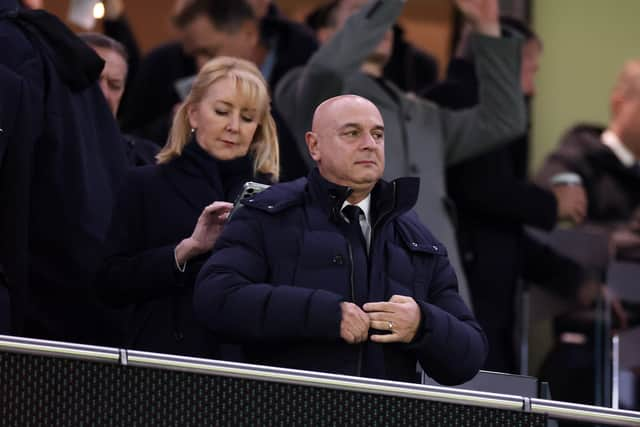

Clubs up and down the country are regularly being let down by poor owners, and there are fears that it could land a number of clubs out of business over the coming years. Meanwhile, there are also clubs like Newcastle United who are effectively owned by states, and controversial ones at that.
The state ownership situation is likely a bridge that can no longer be uncrossed, but it’s still felt by many that the current ownership tests employed by the Premier League and FA are not fit for purpose.
But Tottenham chairman and part-owner Levy feels there is no place for government regulation in football. He told The Overlap: “We’re going through a period of change. The Premier League is the most competitive league in the world, more now than it’s ever been. We’re now going to have some government intervention and regulation, which personally I’m not in favour of, but we have to accept it and embrace it. Sustainability is fundamental to the game for the whole of the pyramid. Multi-club ownership is another issue that is very important today, because it really didn’t exist five years ago.
“The idea that one club is involving lots of different clubs, with the money involved today, must be controlled carefully. We have financial control measures, and it can be abused. It worries me a little because there’s so much money in the game now, and you only need one owner to do something inappropriate, and it would impact confidence from sponsors and broadcasters in the European game – it needs to be very tightly controlled.”
Salford City owner Neville disagrees, hitting back: “I feel that someone needs to be an arbitrator. I haven’t got faith in the FA at this time that they are strong enough to be able to govern the powerful people in the Premier League and the ownership of the clubs. As Daniel Levy said, every club owner is looking after themselves, so who is looking after the wider game? The game is creating these fractures whereby it’s becoming more distinct and difficult to get the game back together again.
“It’s a last chance saloon – government is the only way of being able to get the game closer together. It’s the fans’ last chance in terms of protection around ticket prices, affordability, accessibility, their club having a fair chance of getting up the league with a fair distribution of revenue.
“I wouldn’t want government intervention into football, but I’ve seen some of the attempts to take the game away from the whole of the pyramid in the last few years, and it scares me to death.”
Levy feels the Premier League are already doing the job the government would ultimately be doing when the government’s new Independent Football Regulator takes root.
“When you look at the cost of the organisation that’s going to go into the public sector, let’s come back here in 10 years’ time and see what the cost is,” added Levy.
“I accept that [agents’ fees and lawyers’ fees cost millions], I’m not in favour of government regulation. A lot of the things that the Premier League have put in place, like the Owners and Directors test, various fan charters, where lots of the issues that regulation was going to cover, we are already doing.”
What does need to change?
One thing Levy is not happy about is the related party sponsorships that bid to find loopholes in Profit and sustainability rules. Clubs can only spend a proportion of their revenue, but what we are seeing is the state-owned clubs set up inflated sponsorship deals from within their countries to the clubs to ensure more money is earned through revenue, thus allowing more spending.
“One of the biggest threats is related party sponsorships,” Levy highlighted. “That’s the area that has to be controlled because if you end up having clubs that are owned by states, which I have no issue with, they can do deals with themselves and that puts them in a competitive advantage over everybody else. That’s an area that must be looked at.”