
Golden girls of the golden era of women's football
St Helens and Dick Kerr Ladies Legends Lizzy Ashcroft and Lily Parr, from the Golden Era of women’s football, have just been awarded Gold Plaques from the Mayor of St Helens, in the palatial surroundings of the Victorian Town Hall with its opulent fittings, grand staircase, clock tower and stained glass windows. The beautiful plaques read: “Inspiring Sporting Women in St Helens” followed by the name of the recipient. Nine sets of descendants of the two footballers, rugby players, athletics and judo heroines were invited to receive the honour on behalf of their relatives.
Lizzy Ashcroft had an unbelievable career, making her debut at the tender age of 16 for St Helens Ladies on 20 April 1921 at Birmingham City’s football ground, St Andrews, in front of a crowd of 30,000. She played 7 more matches that season, including games at The Hawthorns and Molineux with the total crowd for her first 8 games being 85,000. She continued to play for St Helens, who were widely regarded as the second greatest team in the country, although matches dwindled after the infamous 1921 English FA ban. In 1923, a Dick Kerr Ladies team facing difficulties and a loss of key players took on Lizzy and her teammates in their native St Helens and were soundly thrashed. The council closed off the Queens Park and charged entry, only for the locals to see Lizzy Ashcroft’s St Helens thrash Lily Parr’s Dick Kerr Ladies by 5 goals to 1, with Lily getting the consolation goal. The rivals, both from St Helens, soon became friends as Lizzy, Lydia Ackers and the footballing great Susie Chorley were invited to join the famous Dick Kerr Ladies. Perhaps the height of their careers was in 1925, when during the tour by the unbelievably glamorous French team, featuring Carmen Pomies and Madeleiene ‘Mado’ Bracquemond, both teams were guests of the Lord Mayor of London and MP Sir Jack Benn Brunel Cohen graced them with tea on the terraces of the Houses of Parliament.
Lily Parr is very famous. Her career for the famous Dick Kerr Ladies has been well documented. She made her debut in her one and only game for St Helens on 22 May 1920 at Blackburn’s Ewood Park. The raw left footed defender had only just turned 15 a month earlier, but was held up as the best player in a 6 to 0 thrashing by the Dick Kerr Ladies. It has to be noted that the DKL had the national French goalkeeper, Louise Ourry, guesting for them in the sticks. Reputedly, Lily was signed up for the Dick Kerr Ladies but she did not make her debut in the famous team of superstars until much later the next season, where legendary captain Alice Kell kept an eye on her at left back. By the time of the famous Boxing Day Game of 45,000 at Goodison Park against St Helens she had been promoted to left wing and her goal scoring exploits began.
During the 1930s, up until the start of WW2, Carmen Pomies helped broker and play in over 68 ‘internationals’ involving representative teams for England, Ireland, France, Wales and Belgium. In 1932 Lily Parr was promoted to captain as the great Florrie Redford had emigrated to Canada and Jenny Harris was playing her last few games. Lizzy Ashcroft assumed the mantle of vice-captain under her great friend. They had both joined the Whittingham County Mental Asylum in rural Goosnargh (village outside Preston), as nurses in 1926, as the general strike had forced them to leave the Dick, Kerr Factory in Preston. The Asylum wanted tall, powerful, sporty women to cope with the patients and both of them, looking like twins and standing at a statuesque 5’ 8” were ideal. Lily Parr took a break from football during 1935 and 1936. By this point she was playing a lot of cricket and hockey for the respected Whittingham Asylum teams and may not have wanted the extra travel involved with the football, on top of a demanding full-time nursing job. This meant that in 1935, when the Dick Kerr Ladies proposed only their second ever tour to France, it was Lizzy Ashcroft who was chosen to lead the tour. Lizzy retired the following year to marry her husband Joshua. Lily stayed single, returned to football and moved back to defence, sometimes playing in goals, as her days of scampering down the wing came to an end. She finally hung up those famous boots in 1951.
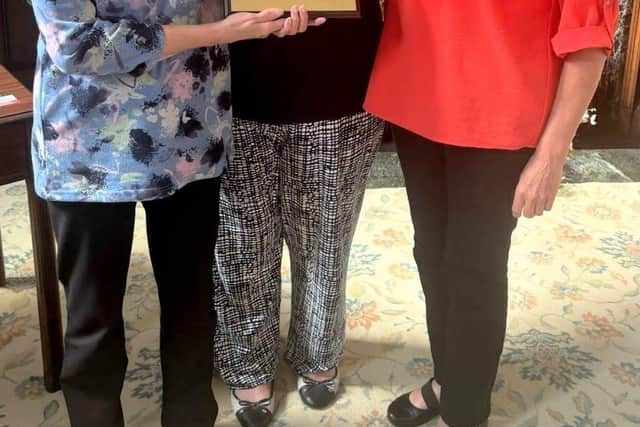

Attending the ceremony for Lizzy were two very proud descendants. Lesley Bailey is the eldest grandchild of Lizzy and was very, very close to her nan. She had the audience in stitches when she explained that she had grown up averse to football thanks to being made to watch Match of the Day on television whilst being babysat by her nan on a Saturday. Preston is a small town, and she herself had briefly worked at the renamed Whittingham Mental Hospital, in her younger days. Her cousin Steve also regularly played cricket at the hospital team, whilst attending the local secondary school. Also receiving the plaque on behalf of the family was Great Niece Anita Ashcroft. Anita was a footballer with St Helens FC in the 1970s and is very proud to be the first woman footballer in the hugely popular St Helens Walking Football Club. She grew up worshipping her nan and spent many years wondering why the famous footballer was not more prominent in the media. Eventually, she read one of grandson Steve’s articles and got in touch with the line: “ you may not know me, but I think we are related”. The two branches of the family, St Helens and Preston, have now reunited thanks to their superstar relation. Mr Culley, great nephew of Lily Parr accepted the plaque for Lily on behalf of the Parr family. He reminisced with Lizzy’s granddaughter Lesley about visiting his great aunt at Whittingham.
The event was hosted by St Helens Mayor Councillor Severiano Gomez-Aspron MBE following a motion raised by Councillor Linda Mussell. The event was organised and managed by Gemma Ireland, Sports Development and Active Lives lead for St Helens Borough Council. The 'Inspiring Sporting Women' plaque scheme was designed to recognise the sporting achievements of women from St Helens. It is hoped that this will lead to increased opportunities for women and girls in St Helens in sport, physical activity and movement. The Gold Plaques of local female role models will be used to inspire women and girls, not just to participate, but to take roles in coaching and leadership, so that they can become the role-models of the future. This is something that the families hold very dear to their hearts, and they are very grateful to St Helens Borough Council for leading the way with this project.