
'She’s the He' review: A coming of age middle finger to trans panic
With inventive visuals, heartfelt writing, and a tampon fight scene for the ages, She’s the He proves indie film is still fearless.
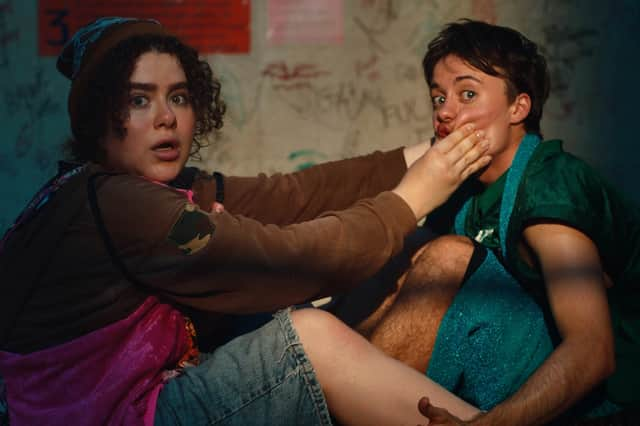
'She’s the He' opens with a premise that immediately raises eyebrows: two boys pretend to be trans women to get closer to the girls they have crushes on.
At first, I was wary of the film's choice to begin this way, but it soon becomes clear that the film is fully aware of what it’s doing.
Rather than exploiting the concept, She’s the He satirises the transphobic panic that dominates much of today’s news cycle, or as Grace Barber-Plentie wrote for the BFI, it's a “proud middle finger to an age of transphobic panic.”

In that way, the film almost becomes the reverse Lady Ballers, rejecting the mean-spiritedness of The Daily Wire’s “comedy” and replacing it with compassion and self-awareness.
Early on, it feels like a hyper-progressive spin on a Disney Channel movie, complete with colourful characters and slapstick dudebro jocks.
For better or worse, the sense of humour here is distinctly American, which for some may be hilarious through its over-the-top cartoon approach. However, as someone with a dry, British sense of humour, it fell flat.
But as the story narrows its focus to Ethan (Misha Osherovich), a teenager who begins to realise she is genuinely trans, the film deepens emotionally and tonally.
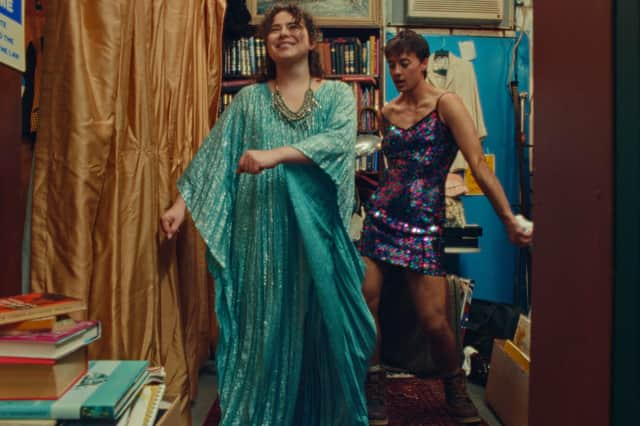
It transforms from a light, goofy teen comedy into a tender exploration of identity, friendship, and the quiet, painful process of coming out.
One of the film’s strongest yet unexpected threads lies in Ethan’s relationship with her mother, Mary, played perfectly by Suzanne Cryer of Two Guys and A Girl fame.
Mary is neither villain nor saint; she’s a portrait of well-meaning ignorance.
Yes, she says the wrong things, like calling Ethan’s transition an attempt to be different, but it stems from misunderstanding, and that nuance feels rare in cinema’s extremist depictions of queer parent-child dynamics.
When Ethan finally explains herself to her mum, it’s not a grand, third-act confrontation, but an intimate, emotionally charged exchange that rings profoundly true.
What for me was undeniably the film’s standout scene takes place at Sasha’s house, where Ethan and Forrest (Tatiana Ringsby) connect over shared experiences of not being cisgender.
It’s a quiet yet powerful moment that even for me, a Queer man, was a reminder that being trans is as much about wanting to live as another gender (i.e. being able to be one of the girls) as much as it is presenting as the gender.
Mark Indelicato’s Davis provides the film’s biggest laughs as the sassy gay friend, and while that trope is tired, Indelicato plays it with such warmth and authenticity that it feels more like a character than a caricature.
Still, the high school comedy plotline about Alex’s deception occasionally undercuts Ethan’s more grounded story.

The colour grading gives the impression of being shot on film, evoking classic teen movies from the ’80s and ’00s while maintaining a contemporary edge.
It’s the kind of unapologetic filmmaking that is Exhibit A in why indie cinema matters and why film as a whole needs to be freed from corporate “polish” and focus-group restraint.
At one point, there’s even a fight sequence where tampons and period pads become weapons, perhaps the first of its kind in film history, and it becomes even better when paired with Time Warp.
Writer-Director Shioban McCarthy also plays with text overlays, which initially felt like visual noise, but later found a poetic rhythm, especially when Ethan starts to write a letter to her mother.
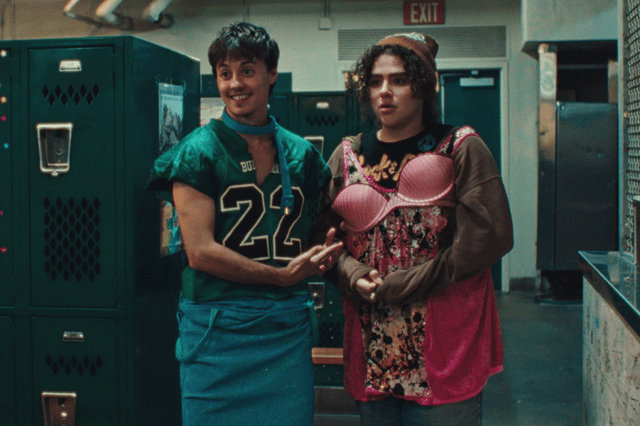
Ultimately, She’s the He is sometimes cringey, often corny, but always heartfelt.
It’s a smart, funny, politically vital indie that manages to say something genuine about trans identity without losing its sense of humour.
The slapstick bullies and over-the-top “bro” energy feel juvenile, though the film earns some leniency, as I think queer people deserve corny comedies too.
In a cultural moment defined by fearmongering and bad-faith representation, McCarthy’s feature stands proudly in sincere defiance.