
‘She looked like me’: How Rachel Yankey showed Jess Clarke she could become a Lioness
Jess Clarke reveals how seeing Rachel Yankey play transformed her view of women's football, highlighting the importance of representation for young Black women.
London 2012 Olympian and former Lioness Jess Clarke explains how seeing Rachel Yankey on television transformed her view of women’s football and why representation still matters for the next generation.
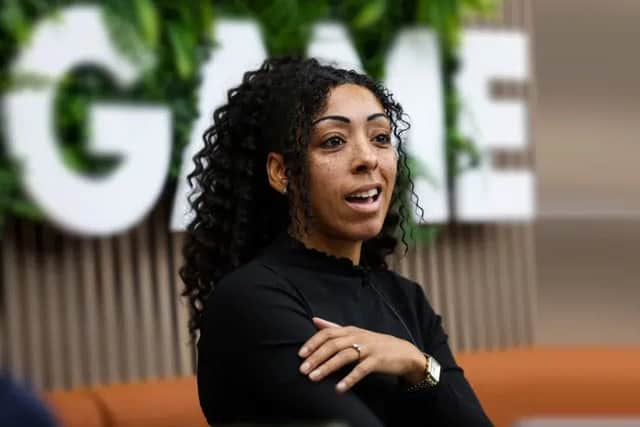

Jess Clarke grew up believing she could one day play alongside Ruud van Nistelrooy at Manchester United, despite women’s football rarely appearing on television. Seeing Rachel Yankey in an FA Cup match changed the picture: an elite player who looked like her and played in the same position.
Jess Clarke went on to earn more than 50 England caps, compete at the 2011 FIFA Women’s World Cup and represent Team GB at the London 2012 Olympic Games. She also played for Liverpool Women and made more than 100 Women’s Super League appearances.
In this exclusive interview with the Diversity and Inclusion Speakers Agency, Jess discusses the moments that shaped her identity, the scarcity of Black women who have represented England and why every girl should know that a career in football is open to her.
Q. When opportunities in women’s football were limited, what gave you the belief that you could make it?
Jess Clarke: “I didn’t focus on the boundaries, that football, especially in the women’s game, there wasn’t really much opportunities there. I focused on what it gave me.
“I didn’t see myself any different, like my race, my gender. I was like, “I’m going to play alongside Van Nistelrooy at Man United.” That’s how I viewed the world, and it worked for me.
“If I did focus on the boundaries, we’ve seen a lot of great players slip through the net: “There’s no opportunity, so I’m going to take a different, alternative path.”
“It was a rarity to see the women’s game on TV. There was this one moment where I did, and it was by chance. I was in the flat that I talked about, in the living room, switched on the TV, and the first thing that came on was a women’s FA Cup game.
“I seen Rachel Yankey playing, and that transformed my worldview. “This could be a thing.” She looked like me and she played in the same position as me.
“That drew my heart and desire even more because I was like, “There is teams out there for me.” I continued striving to play, and then I dug deeper into the women’s game from that moment.
“Then there was the film Bend It Like Beckham. She was called Jess, played the number seven and had a scar. I’ve got a scar down the left-hand side of my body.
“I was like, “This is just crazy. It’s like they’ve made a film about me.” Again, she looked like me, and I drew a lot of inspiration from that.
“We’re seeing the women’s game begin to build, and we’re seeing where it is now. It’s still evolving, but them little moments and snippets really made the difference in my worldview.”
Q. What difference does it make for young Black girls to see players who look like them representing England?
Jess Clarke: “We’re seeing it now, the opportunities. It’s such an exciting time for young people.
“I’m only one of 26 Black women, which is a very small minority of players to ever have played for England. If you look at that statistically, there’s a gap.
“There’s still a lot at grassroots in terms of accessibility and opportunity. We spoke about the engagement, the drop-off. There’s a lot that still needs to progress.
“I’ve had conversations with the FA. They’re looking into it.
“We need to not forget not every young girl wants to play football, but the important thing is that they’re given the opportunity to, and they know that the opportunity is there if they want a career in football. That never used to be the case.”
Q. You have faced barriers linked to race and gender. What helped you push past other people’s expectations?
Jess Clarke: “I feel when we over-identify with things too strongly, over-identification creates wars. It creates so much friction, and you see it across social media.
“The best person for the job, regardless of race, age, sexuality or gender. It doesn’t matter. If you’re good at what you are doing, you should be given the opportunity.
“It’s not a quota that we hit. I don’t want to be given an opportunity because of the colour of my skin. I want to be given an opportunity because I’m the best person for the job.
Don’t look at how I look. Look at who I am, what I can offer and what I can provide. It’s really important.”
Q. How would you like to be remembered, both as a footballer and away from the game?
Jess Clarke: “Within football, I’ve always prided myself on being a nice person. For all the great stuff that I’ve maybe done, the great performances, you’re always remembered by how you were.
“I know some really successful people, and unfortunately I’ve heard in rooms, “Not a very nice person,” and that’s how their legacy is then left. It’s really sad because, for all the great things that you’ve done, it’s overshadowed by the negative interactions that you’ve had.
“Within football, I want to be known to be a nice person.
“Away from football, my legacy, I want to show people that they are far greater than they ever thought possible. We never stop learning. We never stop growing.
“Your dream, your goal, your ambition, whatever that may be, it’s available to you. It’s about how you frame it and the techniques and tools that you can utilise to reach that desired outcome.”
This exclusive interview with Jess Clarke was conducted by Tabish Ali of the Motivational Speakers Agency.