
Massive revamp for Liverpool Street Station a ‘billion-pound gamble’ as green row intensifies

Network Rail’s planned redevelopment of Liverpool Street Station fails to meet key carbon emission policies and should be refused, according to a report by a leading expert.
Simon Sturgis, founder of Targeting Net Zero and a Government advisor, added the proposed scheme features a “flawed assessment” of its carbon emission impacts, warning this had led to potentially misleading conclusions.
James Hughes, Director of the Victorian Society, said Mr Sturgis’s report shows the scheme “fails to abide by local and national policy, is environmentally backward, and would be redundant upon completion”.
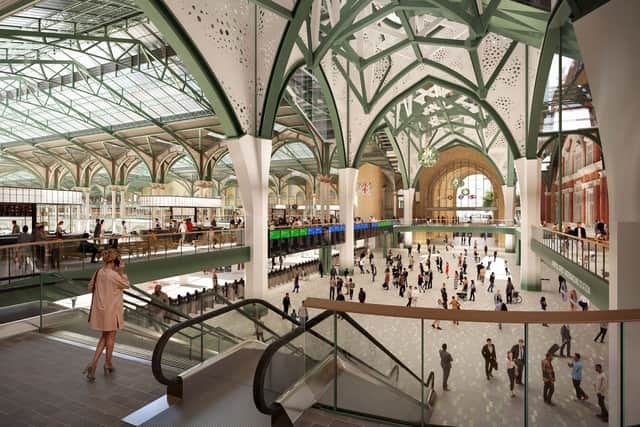

A spokesperson for Network Rail said Liverpool Street Station is overdue a required transformation, and that the investment will allow it to grow by 30 per cent a year “while enhancing accessibility for all”.
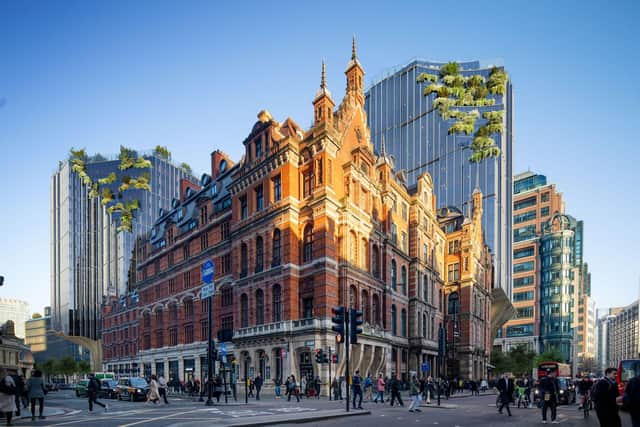
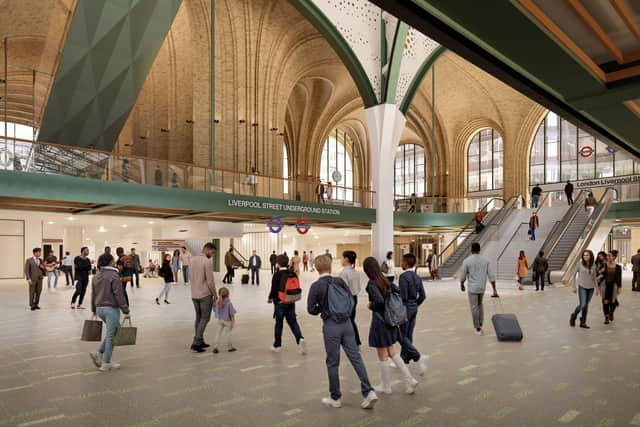
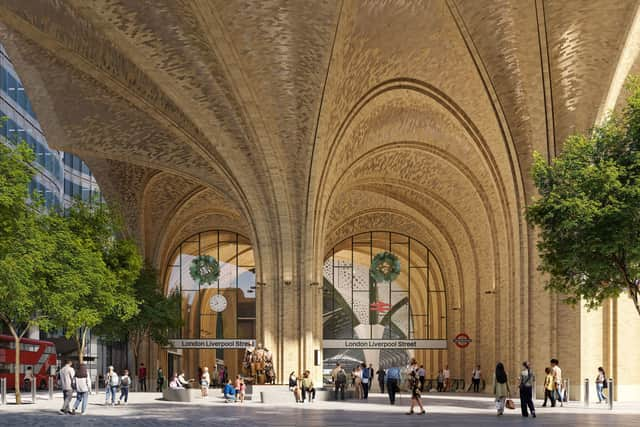
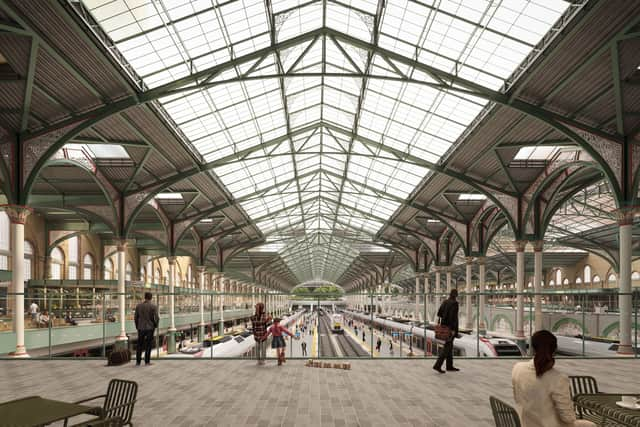
Network Rail’s proposed redevelopment, drawn up by architecture firm Acme, would see the construction of an 19-storey office block above the Grade II-listed trainshed as well as a host of changes to the station itself, such as more ticket barriers and lifts.
It was submitted with the City of London Corporation earlier this year after a previous scheme involving developer Sellar and architects Herzog & de Meuron was ditched.
That proposal, which would have seen a 21-storey block cantilevered over the trainshed and the Grade II*-listed Andaz Hotel, drew more than 2,000 objections.
Sellar and Herzog & de Meuron were replaced, with Acme stepping in to work on the new scheme.
Trade publication Building previously reported Sellar and Herzog & de Meuron are redesigning the original project without the approval of Network Rail and have consulted several heritage groups on the revisions.
The current application has drawn some support, with more than 1,000 letters backing the scheme submitted with the Corporation.
Historic England, while maintaining the proposal would still cause “a great deal of harm”, has also described it as a “significant improvement”. It has however continued to attract extensive criticism, with 2,101 objections recorded at the time of writing.
Mr Sturgis’s report, which was commissioned by the Liverpool Street Station Campaign (LISSCA), examines the carbon emission impacts of the application.
In it, he claims there are significant flaws in the carbon assessment figures included in the submission, which he writes could underestimate the whole life carbon impact by 15 to 25 per cent.
“All carbon assessment figures should therefore be considered invalid, and the submission should be rejected on this basis,” he writes.
Mr Sturgis also claims the proposed redevelopment would miss key benchmarks and policies such as the UK Government’s Net Zero trajectory.
On demolition, he claims this would be “extensive and predominantly involves fabric that has not reached the end of its useful life”.
He adds: “Fabric and buildings subject to demolition are therefore entirely capable of retention and reuse. The concerns with respect to demolition are specifically associated with the buildings that face onto Liverpool Street and Bishopsgate.”
The Victorian Society is one of a number of conservation groups which form the LISSCA.
Commenting on Mr Sturgis’s findings, Mr Hughes said: “This report shines a stark and revealing light on one of the profound shortcomings of the Liverpool Street Station scheme. Network Rail claims that its scheme is environmentally exemplary.
“What this report demonstrates is that the scheme is anything but. It fails to abide by local and national policy, is environmentally backward, and would be redundant upon completion. On this basis alone it should be rejected.”
Henrietta Billings, Director of SAVE Britain’s Heritage, another member of the LISSCA, said it is “shocking that a building designed in 2025 should be based on a 1990s rationale”.
Ms Billings continued: “The design and construction industry has made huge strides in the face of the climate emergency and there is no longer any excuse for last-century thinking. We urge the City of London to give this application the short shrift it deserves.”
A spokesperson for Network Rail said: “As Britain’s busiest station, Liverpool Street is long overdue the transformation it deserves. The current station can’t accommodate expected growth. This investment in sustainable transport will allow the station to grow 30 per cent from 115 million to 150m passengers per annum while enhancing accessibility for all.
“The redevelopment of Liverpool Street makes a vast contribution to reducing the carbon footprint in London through the significant upgrade which will enable two billion additional passengers to undertake sustainable journeys over the next 60 years.”
The spokesperson added the application is designed to emit no carbon in use, with low carbon materials during construction, and will utilise proceeds from the scheme to fund improvements to the station.
“The vast majority of the existing station is being retained and refurbished. 50 Liverpool Street, which was built in the 1980s, and its supportive structural columns, will be removed to allow the London Underground ticket hall below it to be enhanced and improved, both in terms of passenger capacity and accessibility. This is critical to improving the connections between the Underground and Overground services and to enabling this passenger growth.”
Mr Hughes previously labelled the plans a “billion pound gamble” after a report found it to not be technically viable due to the expected costs of revamping the Victorian site.
A spokesperson for Network Rail told the Local Democracy Reporting Service (LDRS) it is confident it can bring the scheme forward at no cost to the customers or the taxpayer.