
Amazing 2,000-year-old Roman basilica hidden beneath Gracechurch Street forces skyscraper redesign

Revised plans for a City of London office block amended after a Roman basilica was found beneath the site have been approved.
A rethink of the 85 Gracechurch Street scheme, green-lit in 2023, was forced upon premises owner Hertshten Properties earlier this year following the discovery.
Initially envisaged as a 32-storey building, changes were made including reducing the size to 30 storeys and installing a public exhibition showcasing the near-2,000-year-old basilica.
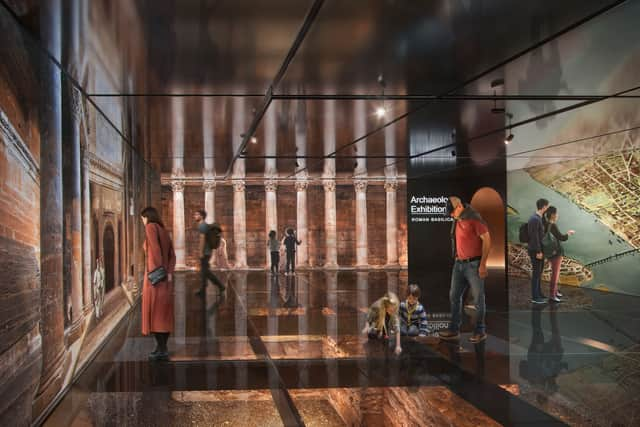

The remains were discovered during investigations by Museum of London Archaeology (MOLA). The location of the ancient basilica was known by experts, though the extent of its preservation proved a welcome surprise. Believed to date to the late 70s or 80s AD it would have formed part of the wider Roman forum.
This would have been the ‘beating heart’ of Roman London, Hertshten Properties previously said in a release, serving as the “political, judicial, commercial, and social hub for residents and visitors”.
Fresh plans were submitted with the City of London Corporation in April, which also featured details including a public walkway providing views of the nearby Leadenhall Market.
It will deliver an increase of around 27,000 square metres of office floorspace compared to the existing building, which will be demolished.
Historic England was among those to raise concerns due to the potential impact on assets such as Leadenhall Market. Objections were also received by some local residents, primarily over the size of the building and the noise and other considerations during construction.
Corporation planners had however recommended the scheme be approved, with members at Tuesday morning’s Planning Applications Sub-Committee meeting (July 8) voting to give it the green light.
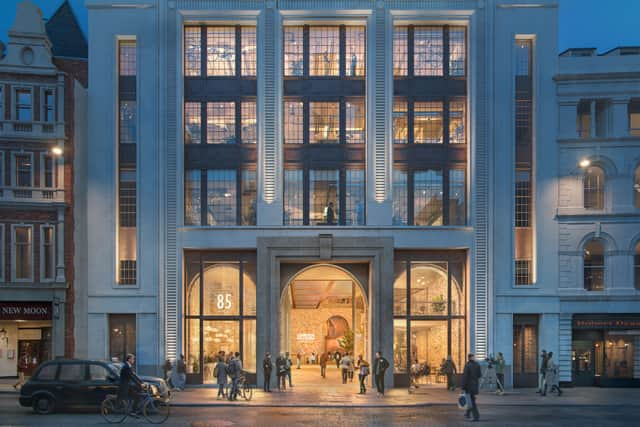
Sophie Jackson, Director of Development at MOLA, told members the proposal would add a “compelling, world-class display of the remains of the first basilica, right in the centre of the City”.
She said: “Finding substantial remains of the basilica is one of the most remarkable discoveries made in the City in recent years, and it has been described as the equivalent to discovering the Speaker’s Chair in the Chamber of the House of Commons in 2,000 years’ time.”
A single objector, Dr Chris Blatchley, who owns a nearby property, claimed the proposal would require the developer to trespass over his home and so breach building regulations. He said the applicant could have set the development back from the site boundary to prevent the alleged overreach, though that this had not been done.
As such, he requested a condition be attached to any approval stating construction of the floors above the foundation cannot begin until developers have shown they can meet the building regulations without trespassing. Dr Blatchley added this would enable some work to start while the issue is resolved.
A Corporation officer clarified national guidance sets out that conditions requiring compliance with other regulatory frameworks should not be used, and so in this context such a condition cannot be attached.
Deputy Shravan Joshi, Deputy Chair of the committee, asked why the building was not taller than the 30 storeys proposed, in particular given its location in the Square Mile’s eastern cluster.
Richard Ward of consultancy DP9 said one of the key constraints is the processional route towards St Paul’s from Ludgate Hill, which influenced the design and meant they could not go much beyond the requested height.
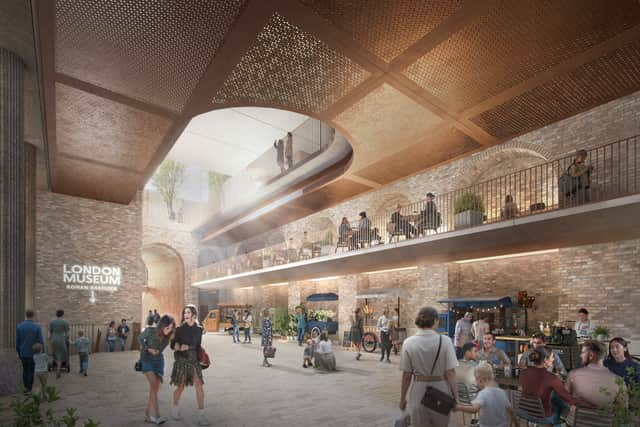
Committee Chair Deputy Tom Sleigh described the application as a “terrific scheme”, and praised the emergence of the basilica as part of the proposal.
“It’s interesting and unusual to have a scheme come back that’s smaller in height, and it’s giving back with the basement too,” he continued. “And the thoroughfare at ground level, which will open additional permeability to pedestrians I think is gracious and interesting as well.
“I think the design, and we are interested in design quality, the design quality is outstanding as well.”
The application was unanimously approved. Following the meeting, Ron Hertshten, Chief Executive of Hertshten Properties (UK) Limited, said: “We are immensely proud to have secured approval for this landmark development that embraces the City of London’s unique history as part of its future.
“With best-in-class commercial space, an immersive exhibition displaying London’s first Roman Basilica, and a new Public Hall, 85 Gracechurch aims to be a ‘quintessentially London’ building in both design and purpose.
“With the City identifying 1.2 million square metres of additional office space needed by 2040, we are delighted to be contributing a significant amount of additional space and of the highest quality. We now look forward to getting on and delivering a world-class destination that will support the attraction and retention of leading global businesses and reinforce the Square Mile’s position as a globally competitive financial district.”
Deputy Sleigh said: “It has always been our ambition to connect the City’s archaeological landmarks into a cohesive and compelling narrative – one that spans over 2,000 years of evolution, ambition, and identity. 85 Gracechurch embodies the enduring spirit of the Square Mile: a place where heritage and progress go hand in hand, and where growth and investment remain integral to its future.”