
Output rises sharply in London as demand growth strengthens
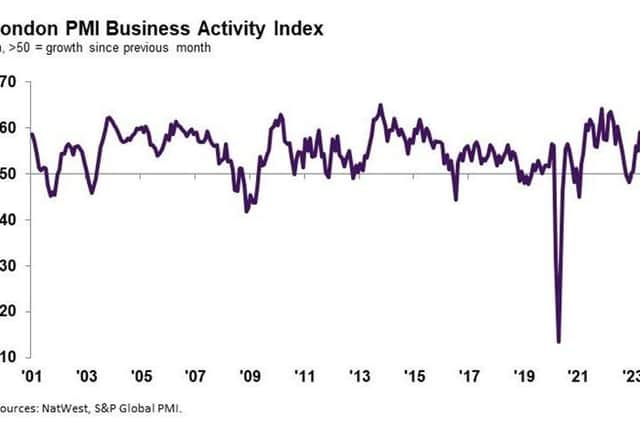
The NatWest London Growth Tracker has signalled a stronger upturn in output across the capital in June, with private sector activity growth quickening from May's seven-month low.
The headline Business Activity Index – a seasonally adjusted index that measures the month-on-month change in the combined output of the region’s manufacturing and service sectors – rose from 54.2 in May to 56.1 in June, indicative of a faster expansion in private sector activity. Higher output was commonly linked to strengthening demand and new business wins.
Having slowed to an eight-month low in May, the rate of growth in demand for London goods and services reaccelerated in June and was marked overall. Bids for new work, greater client uptake and signed contracts were among the reasons quoted by panellists for higher sales.
Companies in London continued to give a firmly positive outlook for the next 12 months of business activity in June. The proportion of firms expecting growth of output far exceeded the proportion expecting a decline, with anecdotal reports citing positive sales projections, greater investment plans and hopes of interest rate cuts. Although still above the long-run trend, the degree of optimism was the softest recorded for seven months.

Higher wages and increased freight costs, due to lengthening shipping times, led to a further rise in costs faced by London-based firms during June. Copper, aluminium, paper and IT equipment were also noted as rising in price. Although a quarter of surveyed firms saw their expenses rise since the previous month, the rate of input price inflation was only slightly higher than May's over three-year low.
Catherine van Weenen, Territory Head of Commercial Mid Market at NatWest, said: "The stronger upturn in London private sector activity was encouraging in June, especially as it was at odds with the weaker national performance. The uplift in new business was also more favourable, as panel reports highlighted the continuation of robust demand conditions and the ability to secure new clients and projects.
"Nevertheless, employment conditions were more on a par with the subdued national trend. Firms are still reluctant to boost their workforces as wage pressures remain the dominant force behind rising costs. Perhaps the slowing of price pressures since the start of the year will support a return to sustainable employment growth in the near future. However, other evidence from the survey suggests that business capacity is quite healthy and that firms are generally able to expand their output with existing resources.”
Performance in relation to UK
London topped the UK regional rankings for activity and was one of only two areas to see growth accelerate (alongside the South West).
The increase in new orders was also much faster than the UK average, and the second-best of the 12 monitored regions and nations (behind Northern Ireland).
Private sector businesses in London continued to restrain their employment activity at the end of the second quarter. Although signalling a fractional rise in jobs during June, the seasonally adjusted Employment Index has averaged near-neutrality since March with only minor monthly changes.
Panel reports indicated that recruitment at some firms was largely offset by restructuring and the non-replacement of leavers elsewhere, which was often due to cost considerations. Notably, the slight rise in employment was in line with that seen across the UK.
Despite staff levels largely stalling at a time of robust sales growth, London companies were able to reduce outstanding workloads for the first time in seven months in June. Some firms mentioned the completion of previous projects freeing up capacity. However, of the monitored UK areas to see backlogs fall in June (11 out of 12), London's was the joint-slowest and marginal overall.
Average prices charged by London businesses rose sharply at the mid-point of the year. The rate of inflation remained much stronger than the long-run trend, but it was the second-weakest in nearly three years and only slightly quicker than May's recent nadir. Survey comments mainly attributed higher charges to the passthrough of rises in wages and additional costs.