
Interview with Cheeyang Ng ahead of groundbreaking musical
In this interview Cheeyang Ng, creator of Māyā: The Musical, discusses the highly anticipated debut of their and Eric Sorrels' groundbreaking show in London’s West End.
Set in 1930s British India, Māyā blends Indian classical music with Western pop to tell the poignant story of Maya Mehta, a young poet navigating the Indian independence movement.
Ng opens up about the creative journey behind the show, its unique fusion of musical styles, and what audiences can expect from this powerful and invite-only workshop on Friday 21st February, directed by Olivier Award-nominated Milli Bhatia in London.
1. Māyā: The Musical has been a long time in the making, and now it’s finally coming to the West End. What does this moment mean to you personally and creatively, and how does it feel to share your work with a UK audience for the first time?


This is such an exciting year for both of us. It feels like both a culmination and a new beginning. Since its inception, we knew that the story needed to debut in the UK. We are especially eager to let audiences here engage with their own history in what we hope is both a great night at the theatre and a chance to dive into a deeply relevant part of Britain’s own past.
2. The musical has a rich fusion of Indian classical music and Western pop. Can you tell us more about the process of blending these two genres to create the unique sound of Māyā?
So much of the score is the result of hours upon hours of research into Hindustani and Carnatic traditions in Indian music. Almost every song is moulded or informed by a raga, and the orchestrations help highlight that fusion to make unprecedented sounds in a Broadway score. It is a sonic landscape that has never been heard in the theatre before — the songs have the depth of expression that comes from Indian modes and vocal stylings and the drive, lyricism, and dramatic momentum of theatrical songwriting.
3. The story of Maya is deeply intertwined with the Indian independence movement. What inspired you to tell this particular historical narrative through the lens of a musical?
When we first conceived the piece, Cheeyang & Eric were both in a moment of crisis. It felt like the world was falling apart, and yet, here we are writing musical theatre. We needed to examine where art meets activism and answer the existential question of whether any of this matters at all.
While this is a significant moment in British and Indian history alike, it also has its place in the legacy of American history. Satyagraha, the philosophy which led to the demonstration known as the Salt March, was deeply influential for Dr. Martin Luther King Jr.’s approach to the American Civil Rights movement.
One of the larger themes of the piece is about how the efforts we make to make a difference are rarely like toppling towers and often more like planting seeds, which future generations must nurture to ensure they bear fruit. This was the inspiration for us — seeing the seeds Gandhi planted in 1930 and earlier with his experiments of blending activism and spiritualism and how they manifested on the other side of the world nearly 40 years later and continue to resonate today.
4. With the inclusion of iconic figures like Mahatma Gandhi, how did you approach the balance between historical accuracy and the fictional aspects of the story?
It’s important to note that when working with history, most dramatic works require some adjusting of details here and there in order to maintain a kind of “theatrical” or “dramatic” truth. Life has no plot or narrative. So while we must honor the specificity of culture and enrich our story with details drawn from true life, we also must take liberties to ensure that the story is structured in a way that satisfies a modern audience Otherwise, we’d be writing a documentary.
This is, in part, why our protagonist, Maya Mehta, opens the show with: “Forgive me now for my use of poetic license. Like Mahatma Gandhi, I am experimenting with truth.” We have found that by keeping real-life participants of this period in history to the perimeter of the plot, a deeper truth in storytelling eventually emerged and made for a more engaging story.
Fun fact, though Mahatma Gandhi is mentioned in the piece, he is not depicted by an actor on stage.
5. You’ve received several prestigious awards, such as the Fred Ebb Award and the Princess Grace Award. How have these accolades shaped your approach to Māyā?
These awards are both affirming and motivating. We are not a team that spends much time resting on our laurels, but instead, try to take these moments of institutional recognition and reinvest them in our projects to help take them to the next level.
6. In the press release, Māyā is described as a musical with the grandeur of Les Misérables and the complexity of Wicked. How would you say these two musicals influenced the style and themes of your own work?
Like Maya, Les Misérables takes a real moment in French history but tells it with a host of fictional characters. In doing so, the world feels grounded and real, but the characters are what ultimately move the audience.
In Wicked, the beating heart of the show, the real relationship to root for, is in the two leading women. So is the case with Maya and her complicated, ultimately powerful relationship with her childhood friend, Harini. But instead of following how the underdog wins, Maya follows what is the responsibility of one in privilege and how does one move to action.
Additionally, both scores have moments of sweeping epic gestures and catchy pop melodies; we strive for the same kind of contrast with Maya.
7. The musical’s core theme revolves around Maya’s self-discovery and her choices in the face of privilege. How do you hope the audience will connect with her journey?
The questions Maya asks on her journey are very much the questions we ask ourselves as artists as we try to engage with the world around us today. Our hope is that by rooting the story in a specific time in history, we can highlight the fact that these questions are timeless and these issues are cyclical and universal.
We hope that for some audience members, Maya can serve as a surrogate for them and create a space that allows them to ask those same questions of themselves and their own world.
8. What has it been like to collaborate with the talented Milli Bhatia as the director for this project? What has her vision brought to Māyā that you’re most excited about?
It has been so wonderful to work with Milli, who is truly a director for living writers. From day one, she has made it clear that her goal is to help bring our story to life, to interpret what we have been developing for years and to make the story as clear and compelling it can be. We are most excited about her dramaturgical mind and the way she will be able to shape three-dimensional performances from the incredibly talented team of actors she has helped assemble.
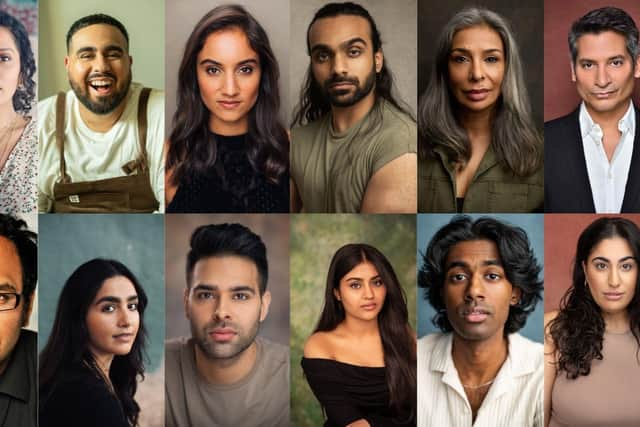
9. With such a diverse and talented cast, including Sharvari Deshpande and Irfan Damani, how did you go about selecting performers who could bring these characters to life in the way you envisioned?
This is truly a global effort; we have talent from India, the United States, and the United Kingdom all uniting to bring this story to life. We cast a worldwide search with the extraordinary support of Sarah Jane Price Casting and Ben Armstrong Casting. We had to comb through so many video submissions, and callbacks in person in the UK, and we were blown away by the level of interest and talent in the South Asian community who came out to be a part of this workshop.
10. Looking ahead, what are your hopes for Māyā: The Musical as it moves forward in its journey? Do you envision it reaching a global audience in the near future?
Absolutely! This is a story with a global team for a global audience. For our next steps, we’ll be staying in the UK. Stay tuned for our developmental production with a regional theatre in the UK. The dream is to bring Māyā: The Musical to The National and the West End very soon!
Māyā: The Musical, created by Cheeyang Ng and Eric Sorrels, is here from Friday 21st February, bringing its groundbreaking fusion of Indian classical music and Western pop to London’s West End for the very first time. More information is here https://www.mayathemusical.com/